Roof rat architectural exclusion serves as the mechanical termination of rodent access routes into attic crawlspaces across Bexar County. In native environments, roof rats ( Rattus rattus ) utilize arboreal travel…
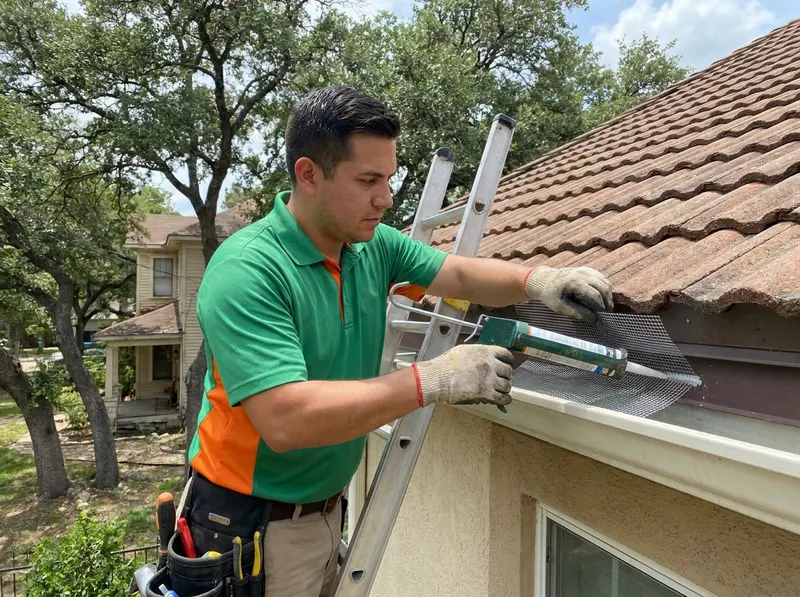
Roof rat architectural exclusion serves as the mechanical termination of rodent access routes into attic crawlspaces across Bexar County. In native environments, roof rats (Rattus rattus) utilize arboreal travel paths, exploiting live oak canopies and creepers to reach structural eaves. In high-density timber environments like Alamo Heights, Terrell Hills, and Monte Vista, these rodents routinely navigate overhanging branches to breach soft construction timber, cedar trim, and non-gauge attic louver vents.
Structural integrity demands an architectural approach rather than toxic baiting; poisoned rodents frequently expire inside wall cavities or drop ceiling chases, creating severe secondary odor and fly infestations during central Texas heat spikes exceeding 100 degrees Fahrenheit. gov/Living-with-Wildlife/Rats">California Department of Fish and Wildlife. CedarQuill Pest Management deploys 1/4-inch 19-gauge hot-dipped galvanized mesh alongside heavy-gauge aluminum flashing to terminate gaps as narrow as 1/2 inch, the minimum clearance necessary for an adult roof rat to compress its skull and enter an attic.
In master-planned developments across Stone Oak, Westover Hills, and The Dominion, Spanish-barrel clay tiles and concrete composite roofs create expansive eave voids.
Properties situated along riparian corridors, including Helotes Creek, King William Historic District, and Southtown, experience continuous rodent pressure due to proximity to the San Antonio River and tributary drainage greenbelts. Standard perimeter chemical applications fail to stop arboreal pests because rodents bypass terrestrial treatment zones entirely.
Structural sealing addresses specific structural junctures: roof-soffit intersections, frieze board clearances along masonry, crawlspace access portals, and uncapped AC chase lines running through exterior siding near the Medical Center.
Executing an architectural exclusion envelope involves a standardized structural workflow: 1. Complete visual roof-plane and attic boundary audit mapping all active and latent breach pathways.
2. html">ASTM-standard galvanized hardware cloth and corrosion-resistant mechanical fasteners. 3.
gov/">Texas Department of Agriculture structural pest regulations. 4. Evacuation of monitored traps and final validation checks over a 10 to 14 day period to verify zero acoustic activity or thermal attic movement before declaring the structural barrier complete.
Every job gets a firm, written price after a free on-site visit.
For standards, safe disposal, and service guidance on pest control services in San Antonio, TX, useful references include U.S. EPA, ENERGY STAR, U.S. Dept. of Energy, Consumer.gov, U.S. Census Bureau, and Google Maps. General consumer and small-business resources are available from USA.gov, Better Business Bureau, FTC Consumer Advice, U.S. Small Business Administration, and Ready.gov.
Tell us about your roof rat architectural exclusion job in San Antonio and we'll send a clear, written quote, usually the same day.
 CedarQuill Pest Management